Share
What an Indie Rockstar Can Teach Photographers
Photo by Dale May Note: This post was originally published on the ASMP Strictly Business Blog. My Yale classmate, Jonathan Coulton, spent the...
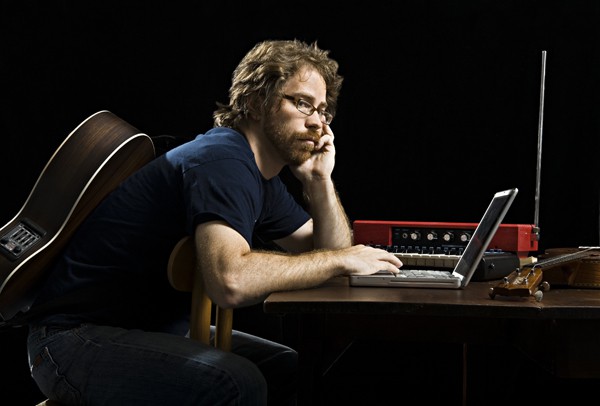
Photo by Dale May
Note: This post was originally published on the ASMP Strictly Business Blog.
My Yale classmate, Jonathan Coulton, spent the decade after graduating from college working as a programmer. I had known Jon as a musician in school, so I wasn’t completely surprised to hear that he was giving it a go. But his approach was very unconventional.
In 2005, Jon forced himself to write a new song each week – a project he called “Thing a Week.” The project served a number of purposes – could he: 1) Work consistently against a deadline in a creative endeavor while still producing high quality work, 2) Use social media channels (at that time, blogs) to gain an audience, and 3) Embrace new intellectual property models (i.e. Creative Commons) and make a living.
The answer to all three questions was yes, and today, Jon makes close to $500,000 year (as reported in NPR’s Planet Money piece on him) without a record deal or traditional marketing, while making all his work available for non-commercial usage through Creative Commons.
The Planet Money piece concluded that Jon was an outlier. In fact, they referred to him as a Snuggie, as in, the thing you didn’t know you needed but you only need one of them before the novelty wears off. But Jon wrote an insightful rebuttal that I thought could easily be applied to professional photographers.
1. Nerd rock isn’t too much of a niche. Jon mentioned other niches like “teenagers in Seattle” or “13-year-old girls on YouTube,” in reference to Nirvana and Justin Bieber. Sure, they have larger audiences, but that shouldn’t discount the viability of his niche.
2. Being “discovered” on Slashdot isn’t his business model. The authors pointed out the main discovery of Jon happened on a nerd/hacker forum, and discounted this as a viable business model for others. But Jon points out that his business model is selling songs and touring. “It’s patently obvious that [this is] replicable because I stole it from every other recording artist in the world.”
3. He owns 100% of his music. During the “Thing a Week” period, he gave music away. This helped to audience build, but because he was transparent about what he was trying to accomplish, he also made a connection to his fan base by pulling back the curtain on being a rockstar.
His Creative Commons license has allowed his fans to also create elaborate music videos, which helps his visibility. He’s not only toured in typical venues, he’s also been the headliner on a couple of sold out cruises.
The music industry has changed dramatically, and one could credibly make the argument that it has seen even more of a downturn than the photo industry. Distribution through CD sales has declined precipitously, and emerging mechanisms like Spotify pay the artist pennies. But Jon has a different take of the gloom and doom:
“I obviously don’t know the details of everyone’s business, but I’m guessing that we have this one thing in common: we’ve all decided that it’s fine with us if we reach fewer people as long as we reach them more directly…We now have an entirely new set of contexts and they come with a whole new set of tools that give us cheap and easy access to all of them – niche has gone mainstream. It is no longer necessary to organize your business or your art around geography, or storage space, or capital, or what’s cool in your town, or any other physical constraint. And this is not to say that anyone can become a moderately successful rockstar just by starting a blog – success is still going to be a rare and miraculous thing, as it has always been. There are just a lot more ways to get there than there used to be, and people are finding new ones every day.”
Today’s “smart” photographer has also embraced this change rather than trying to fight the machinery of yesterday. Jim Goldstein built over 1 million followers on Google+. David Sanger has 65,000 followers on Instagram. Gerd Ludwig funded his Chernobyl project through Kickstarter. These change-embracing photographers are looking for ways to reach audiences through different channels, and in the process, they’re developing a degree of intimacy with their constituents that didn’t exist before.
This isn’t to say that your big advertising jobs should go the way to the dodo. But diversification of your income stream and audience is no different than having a balanced stock portfolio. Today’s technology makes this possible to the sole proprietor in a way that we could have never imagined even 10 years ago.
A couple of years ago at a reunion in New Haven, Jon and I were having a drink at a bar when an attractive young lady came up to us. She gave us the once over, and said, “Are you Jonathan Coulton? I love your stuff. I just saw your show in Boston the other week!” If this is life as a Snuggie, then sign me up.
You May Also Like
-
Expert Advice and Top Tips from Pro Photographers for 2024
What’s one piece of advice you would give to aspiring or up-and-coming photographers? We asked nine experienced photographers and PhotoShelter members to share their top tips for those looking to get ahead in their photography careers. From finding your own visual voice to working with a mentor or photo assistant, each piece of advice listed […]
-
What’s On Your Photography Holiday Wish List?
The holiday season is around the corner and that means it’s the perfect opportunity to upgrade your gear or find that special gift for the visual storyteller or photography enthusiast in your life. We reached out to a handful of renowned photographers and PhotoShelter members, each with their unique styles and preferences, to bring you […]
-
Share a Photo That Means the World to You
We all have a photo that means the world to us. Maybe it’s one we made ourselves – the first photo from our first camera. It could be an old family photo in a beloved photo album. Or maybe it’s an iconic image that hangs on our wall at home. With World Photography Day coming […]